Prologue
What this site is — and why
"AKTE GLADBACH" is for lovers and haters of the Foals alike. History becomes legend, legend becomes myth. And myth becomes cult — or a reason for eternal second-hand embarrassment, depending on the event.
The longing for a title. When "the ancestors" become a burden. Five championships, two UEFA Cups — but all before 1980. Since then, the Foals have been fighting against their own past. Netzer, Heynckes, Bonhof — the legends of the Bökelberg cast long shadows. Gladbach is the club that proves past greatness can be both a blessing and a curse.
But this site goes beyond mere celebration or hatred. Akte Gladbach is structured in three parts: The Club Dossier tells the story — triumphs, tragedies, scandals, heroes and failures across 12 chapters. Match Intelligence delivers the live data a professional needs: squad, statistics, head-to-head, injuries, form. And Predictions brings it all together — with prediction markets.
Prediction markets are not gambling. In traditional sports betting, the masses lose — the money goes to the bookmaker who has built in his margin. Betting exchanges are similar: commissions on winnings, liquidity shortages and spread eat into returns. Prediction markets work fundamentally differently. There is no bookmaker who lets the house win. Instead, money flows from those who don't know to those who get it right — with risk management, portfolio diversification and disciplined capital deployment. You can trade 24/7, build and close positions, and wait for the binary resolution of the event. Those who understand it are not speculating — they're engaged in systematic trading.
Akte Gladbach is part of Akte Bundesliga — the same concept for all 18 Bundesliga clubs. Each club gets its own dossier, its own intelligence, its own predictions. The big picture can be found at aktebundesliga.net.
Profile
Facts, figures and milestones
Steckbrief – Facts, figures and milestones
Borussia Mönchengladbach's full name is Borussia Verein für Leibesübungen 1900 e.V. The club was founded on August 1, 1900 (under the name FK Borussia 1900).
Borussia play at the Borussia-Park (54,067 seats). The club colours are black, white and green, and membership exceeds 85,000. They are Germany's sixth-largest club (as of December 2019) with more than 1,000 fan clubs across the country.
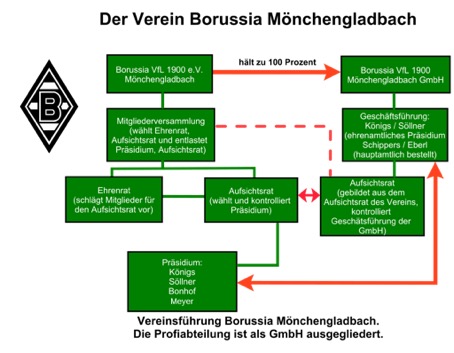
The professional football division is operated by the capital company Borussia VfL 1900 Mönchengladbach GmbH, which is 100% owned by the registered association.
Good to Know
What few people know
Borussia Mönchengladbach's first team were promoted to the Bundesliga in 1965 and had won five national championships, three DFB-Pokal titles and two UEFA Cups by December 2019. They occupy sixth place in the Bundesliga all-time table. The attacking style of play that thrilled the Bundesliga in the late 1960s and 1970s earned them the nickname "the Foals" and established them as one of Germany's most romantic football institutions.
That much is known. Less well known is that the founding of Borussia Mönchengladbach was chaotic. A group of young footballers, deeply dissatisfied with the local sports club at the turn of the 20th century, broke away and founded their own association under the name FK Borussia 1900. To secure a proper pitch, the fledgling club then merged with a local parish — a pragmatic alliance born of necessity.
Borussia were not among the Bundesliga's founding members and were merely a regional force in German football before 1965. After the Second World War, the club played two seasons in the Landesliga before oscillating between the 2. Liga West and the then-top-flight Oberliga West from 1949/50 onwards. What few people know: the club won their first title — the Western German championship — in 1920.
Under new coach Hennes Weisweiler, Borussia Mönchengladbach won promotion to the Bundesliga in the 1964/65 season — simultaneously with FC Bayern München. This is also when the nickname "the Foals" took hold. What few people know: it carries a double meaning. It refers to the "young foals" because Weisweiler fielded a squad with an average age of just 21.5 at times — and to the horse on the city's coat of arms.
What is also easily forgotten: Gladbach won the 1970/71 German championship despite losing two points at the "green table." Neither the team, nor the coach, nor the fans were at fault — the local authority was. During the home match against Werder Bremen, Herbert Laumen crashed into the goal net after an aerial duel with Bremen goalkeeper Günter Bernard, the post buckled, and the match had to be abandoned. The Bundesliga awarded the points to Bremen.
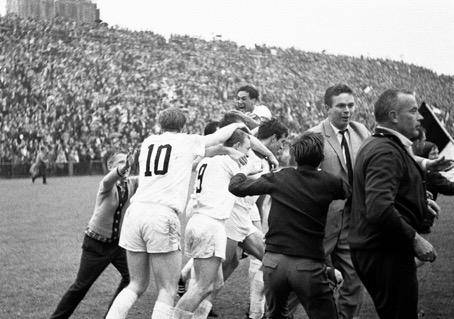
Nevertheless, Gladbach managed to win the title that season — and not just that: they became the first Bundesliga club to successfully defend their championship. In spectacular fashion, aided by a special motivational trick few remember today: after the first title in 1969/70, BMG caught FC Bayern on the final day of the 1970/71 season — a dramatic finish that entered Bundesliga folklore.
Udo Lattek succeeded Hennes Weisweiler as BMG coach. That is well known. What is largely unknown is that Lattek behaved rather dishonourably during the switch. Not towards Bayern or Gladbach, but towards Rot-Weiss Essen. After his dismissal at Bayern, the then-40-year-old Lattek sought a new challenge — and initially committed to the Essen club before reneging on the deal to join the Foals.
For the Haters
Embarrassing disasters and major defeats
The phase from 2004 to 2010: The years from 2004 to 2010 were a period of embarrassing management blunders by the club leadership. The club showed no coherent strategy in squad building, sporting director appointments or coaching hires, and became the new KaDeWe — a department store of misguided transfer spending.
0-11 against Glasgow Rangers: In the European Cup Winners' Cup in 1960, Gladbach received a brutal introduction to international football in their very first competitive European tie. They lost 3-0 at home to Glasgow Rangers, then suffered an 8-0 hammering in Glasgow.
Failure in Madrid: In the 1985/86 UEFA Cup round of 16, Borussia Mönchengladbach faced Real Madrid. The Foals made short work of the first leg, winning 5-1. Yet they were eliminated. In the return, Santillana scored in the 89th minute for Real Madrid to make it 4-0 on the night — a collapse for the ages.
DFB-Pokalfinale 1992: Nach einem gewonnenen Elfmeterkrimi im Halbfinale gegen Bayer Leverkusen trifft BMG im DFB-Pokalendspiel im Jahr 1992 auf den damaligen Zweitligisten Hannover 96. Man verliert nach einem 0:0 nach Verlängerung im Elfmeterschießen. Eine Mega-Blamage zum denkbar ungünstigsten Zeitpunkt.
The 1998/99 season: Gladbach have been relegated twice, each time as bottom of the table. In 1998/99, Borussia won 3-0 against Schalke 04 on the opening day and stood at the top of the table for the last time in 13 years. What followed was a catastrophic campaign ending in the drop.
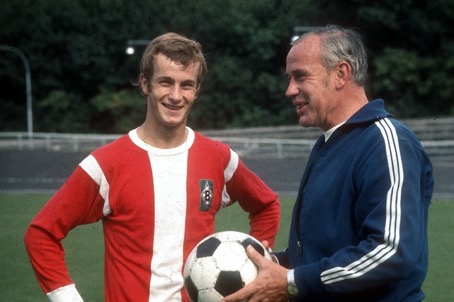
Even Heynckes couldn't fix it: In the 2006/07 season, Borussia were knocked out of the DFB-Pokal by Regionalliga side VfL Osnabrück in the second round. The league misery continued. After a dismal first half of the season with just 15 points, the situation looked desperate.
Heaviest defeats: BMG's heaviest defeats both ended 0-7 — away at Stuttgart on September 18, 2010 and at home against Bremen on April 30, 1966.
For the Lovers
Key triumphs and major victories
Borussia Mönchengladbach's greatest successes: Gladbach won the German championship in 1969/70 and 1970/71, achieving the first-ever Bundesliga title defence. The team then won three consecutive championships — 1974/75, 1975/76 and 1976/77. Gladbach are two-time UEFA Cup winners (1975, 1979) and three-time DFB-Pokal winners (1960, 1973, 1995).
UEFA Cup 1973, 1980 and European Cup 1977: Three times they came agonisingly close. The international final appearances in the UEFA Cup in 1973 and 1980, and in the European Cup in 1977, also rank among the club's great achievements. In 1977, they lost the European Cup final to Liverpool — a defeat that still stings.
Fortune in Düsseldorf's Rheinstadion: The last international title came rather fortunately. On May 23, 1979, Borussia beat Red Star Belgrade in the UEFA Cup final in Düsseldorf. A 1-0 win (first leg 1-1) saw Udo Lattek's side lift the trophy — thanks to a fortunate penalty decision.
DFB-Pokal winners 1973: In 1973, Borussia Mönchengladbach beat 1. FC Köln 2-1 after extra time in what is widely considered the greatest DFB-Pokal final in history. The decisive goal was scored by Günter Netzer, who substituted himself on in his final match for Gladbach, three minutes into extra time — one of the most iconic moments in German football.
DFB-Pokal winners 1960: The first national title — and the most surprising — was not won by Borussia Mönchengladbach, but by a club with a different name: the 1960 DFB-Pokal was won under the old city name München-Gladbach. On October 5, 1960, Borussia defeated Karlsruher SC 3-2 in the final.
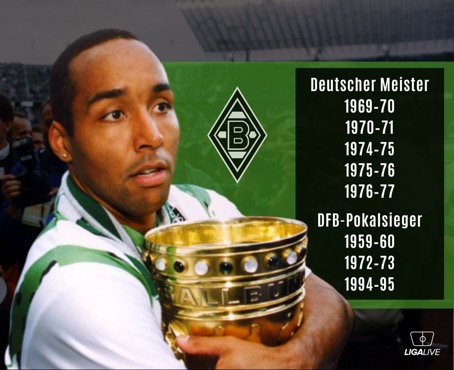
DFB-Pokal winners 1995: Gladbach's last national title to date (as of December 2019) came in 1995. Bernd Krauss's team featuring stars Effenberg, Pflipsen, Andersson and Dahlin won 3-0 in the DFB-Pokal final against second-division VfL Wolfsburg.
Most Important Persons
The men who shaped the club
The playmaker: Few players dare to undermine their coach's authority. Fewer still would substitute themselves on. Günter Netzer did. Under the eyes of the disciplinarian Hennes Weisweiler, Netzer brought himself on in the 1973 DFB-Pokal final — and scored the winner. The most iconic act of defiance in German football history…
The record holder: "That one will go places," coach Hennes Weisweiler told the German national team when introducing Berti Vogts in 1967. The defender had already been playing for Borussia for two years. Vogts went on to make more appearances for the club than any other player — a record of loyalty and consistency…
The "Don": It is no coincidence that Borussia Mönchengladbach's postal address today is "Hennes-Weisweiler-Allee 1." Under his leadership, the Foals rose from provincial club to internationally recognised force with an unpronounceable name — the architect of everything Gladbach became…
"The striker star": Allan Simonsen was named European Footballer of the Year in 1977. Simonsen played for Borussia Mönchengladbach from 1972 to 1979. Hennes Weisweiler spotted the 165-centimetre striker at the Olympic Games — and signed the Dane who would become one of the most lethal forwards in Bundesliga history…
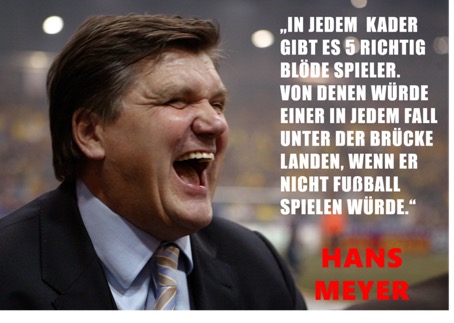
"The Communist": "I was only their twelfth choice," Meyer quipped at his introduction as new Gladbach head coach in September 1999. Dry wit and self-deprecation were his trademarks — Meyer's quips rank among the most-quoted in Bundesliga history…
Goalkeeping legend: Kamps arrived from Düsseldorf in 1982 and stayed for 22 years as a player alone. He made 390 Bundesliga appearances — only Berti Vogts played more matches for Borussia. The goalkeeping legend later became youth coach, continuing his service to the club he loved…
Personae Non Gratae
The men fans love to hate
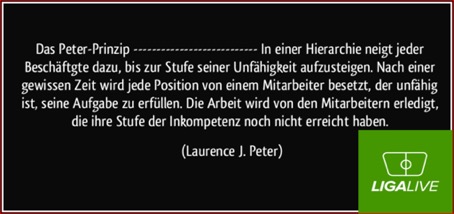
The Peter Principle: In April 2005, Borussia Mönchengladbach hired Peter Pander as successor to the departed sporting director Christian Hochstätter. Pander oversaw the most expensive transfer in club history at the time — a signing that spectacularly failed to deliver, embodying the principle that people rise to their level of incompetence…
The unsuccessful one who waived his severance: Between November 2004 and April 2005, the Dutchman was responsible for Gladbach's fortunes. As successor to Holger Fach, Advocaat was supposed to bring calm — but delivered only more turbulence. Remarkably, he waived his severance payment upon departure…
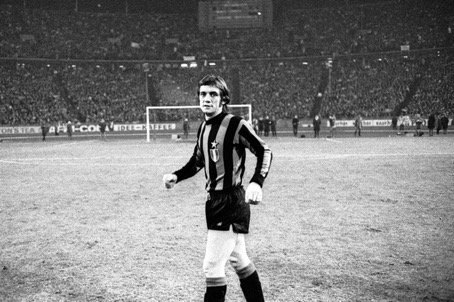
The "cola can victim": Roberto Boninsegna sabotaged Borussia's finest European performance 48 years ago in the most dramatic fashion. In the 29th minute against Inter Milan, with Gladbach leading 2-1, a cola can was thrown from the stands. Boninsegna used the incident to get the match annulled — a scandal that haunts Gladbach to this day…
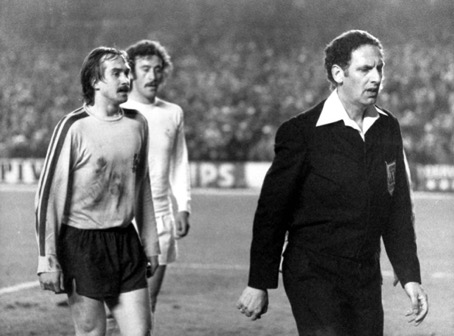
Scandal in Madrid: "The referee robbed us of victory," Jupp Heynckes summarised the events of that scandalous evening. In the 1976 European Cup quarter-final against Real Madrid, the match was overshadowed by blatantly biased officiating that denied Gladbach a deserved progression…
Wanderer between Borussia worlds: His summer 1995 transfer to the Westphalian Borussia made the Bundesliga top scorer public enemy number one at the Bökelberg. Shortly before the move, he had pledged something like "eternal loyalty" to Gladbach — a promise that made the betrayal all the more bitter…
The "Judas": No other player's departure to FC Bayern München was taken as personally in Gladbach as Lothar Matthäus's. In his final match for the Foals — the lost 1984 DFB-Pokal final — he scored against his future employer, only to join them days later. The ultimate treachery in Gladbach eyes…
Tragic
Those who suffered misfortune
Robert Enke — death by suicide: In 1999, Robert Enke left Borussia Mönchengladbach for Benfica Lisbon. From there he moved to FC Barcelona, Beşiktaş Istanbul and finally Hannover 96. In November 2009, Robert Enke took his own life. His death shook German football to its core and sparked a national conversation about mental health in professional sport.
Henning Jensen — death at 68: As a player, Henning Jensen won almost everything. Two German championships with Borussia Mönchengladbach (1975 and 1976), two Spanish titles with Real Madrid (1978 and 1979) and the 1980 European Championship with Denmark. The Dane died in 2017 at the age of 68.
Steve Gohouri — death at 34: Steve Gohouri died at 34. The former Gladbach player had been missing for more than three weeks before his body was found on the Rhine bank near Krefeld on December 31, 2015, according to Düsseldorf police. The autopsy could not conclusively determine the cause of death.
Marcelo Pletsch — the Brazilian enforcer: Marcelo Pletsch played for Borussia Mönchengladbach from 1999 to 2005. Towards the end of the 2004/05 season, he was suspended for comments damaging to the club. Pletsch made headlines with a foul on Werder Bremen's Ailton that became one of the most notorious tackles in Bundesliga history.
Shmuel Rosenthal — the first Israeli: Shmuel Rosenthal was the first Israeli professional to play in the Bundesliga. In 1968 he represented Israel at the Olympic Games in Mexico, and in 1970 at the World Cup — also in Mexico. He played for Gladbach from 1972 to 1974, a pioneering figure in German football history.
Karl Del'Haye — Bayern ruined his career: Before the 1980/81 season, European Championship winner Del'Haye moved to FC Bayern München for the then-record fee of 1.3 million Deutschmarks. His career hit a dead end. Under coach Pál Csernai, he sat on the bench or in the stands — the textbook example of a talent squandered by a bad transfer.
Hans-Jörg Criens — the king of all super-subs: Hans-Jörg Criens died at 59 of a heart attack. The third-most prolific Bundesliga scorer (92 goals) in club history passed away eight days after his birthday at Christmas 2019. Criens never won a title, but scored decisive goals — a cult hero beloved for the moments that mattered most.
21.https://de.wikipedia.org/wiki/DFB-Pokal-Halbfinale_1984↩
OMG — Oh My God
You can't be serious
Borussia Mönchengladbach wird zwei Mal bei internationalen Spielen betrogen.
Europapokal der Landesmeister 1971/72
In the 1971/72 European Cup, the club were eliminated by Inter Milan. In Milan, the team around captain Günter Netzer lost 4-2; the return in Berlin ended 0-0 with Borussia missing a penalty. The Berlin match was already the third fixture, because the original home leg in Mönchengladbach was annulled — the infamous cola can incident.
Borussia Mönchengladbach were leading 2-1 after barely a third of the match in front of 28,000 spectators. In the 29th minute, a scuffle broke out near the touchline between Gladbach's Ludwig "Luggi" Müller and Inter star Roberto Boninsegna. A drinks can flew from the stands towards Boninsegna. The Italian collapsed dramatically.
"Luggi" Müller disagreed. "Suddenly a can came flying and hit Boninsegna on the shoulder," the defender recalled. "I kicked the can on the ground and noticed it was empty." At the urging of teammates, Boninsegna had thrown himself to the ground. And when he tried to get up, Inter's medical staff pushed him back down — the theatre had begun.
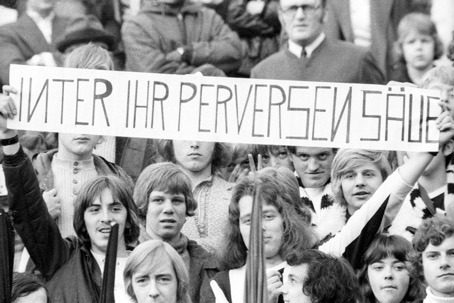
The investigation proved difficult for Mönchengladbach police. The thrower could not be identified. One man detained in the stadium turned out to be innocent. According to the police report and some witness statements, an Italian fan may even have been the culprit.
Incidentally: the cola can is now on display in the Gladbach club museum, and Roberto Boninsegna later pursued a career as an actor in a Terence Hill film. And truly: apart from the Gladbach goals, there are no TV images of the match — the ARD declined to broadcast it live due to an additional VAT charge of 6,000 Deutschmarks.
Europacup der Landesmeister 1975/76
In March 1976, Borussia were eliminated under dubious circumstances at Real Madrid. The guilty party: referee Leonardus van der Kroft and the entire Dutch officiating team.
Fun Facts
Knowledge for blowhards, braggadocios and connoisseurs
Borussia: The name Borussia is the Latin word for Prussia, to which the Lower Rhine city of Mönchengladbach (then: München Gladbach) belonged when the club was founded.
October 31, 1969 — where it all began: On Reformation Day, "the Foals" beat Alemannia Aachen 5-1 at home and overtook champions FC Bayern München (who lost 1-2 at home to Hertha BSC) to go top of the Bundesliga for the first time on matchday 11 of the 1969/70 season.
The cult ground: The Bökelberg stadium, Gladbach's cult venue, was converted back into a football ground by the British occupiers after the Second World War. It had briefly served as a tank workshop and was extensively damaged during the war. In 1914, Borussia Mönchengladbach acquired the site on Bökelstraße — the beginning of a love affair between club and ground that lasted nearly a century.
A "bank robber" named Helmut Grashoff: In July 1962, Borussia appointed Fritz Langner as new coach, who had won the western German championship with Westfalia Herne in 1959. The new leadership then sold international Albert Brülls for a record fee of 250,000 DM to FC Modena — much to the new coach's dismay.
Highest Bundesliga win: Gladbach's record Bundesliga victory came with the 12-0 demolition on matchday 34 of the 1977/78 season. It was a futile win. The championship went to Köln, coached by Hennes Weisweiler, who still had the better goal difference. It was one of four(!) double-digit victories by the Foals.
Another record belongs to the Gladbach vs. Dortmund pairing: in the 1965/66 promotion season, there were five penalties in a single match. Dortmund won 5-4 at the Bökelberg, partly because Gladbach's Egon Milder hit the crossbar with the third Gladbach penalty in the 78th minute — sealing the first home Bundesliga defeat in club history.
1954 World Cup winner: Before the Bundesliga era, Gladbach briefly had a World Cup winner in their ranks. World Cup-winning goalkeeper Toni Turek wound down his career at the club in 1956 and 1957, making four appearances.
Negative streak against Bayer Leverkusen: Against their neighbours from the right bank of the Rhine, BMG hold a particularly painful record. From 1989 to 2004, they went 22 Bundesliga matches without a win against Leverkusen, including 16 draws — the longest "bogey team" streak in Bundesliga history as of December 2019.
Most double-digit wins: Borussia Mönchengladbach are the Bundesliga club with the most double-digit victories as of December 2019. Six times has a team scored ten or more goals in a Bundesliga match — four of those were by the Foals from the Lower Rhine.
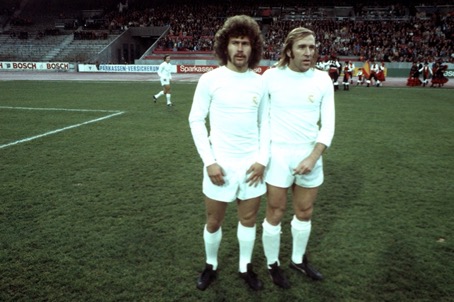
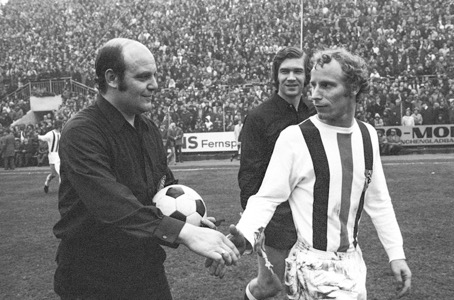
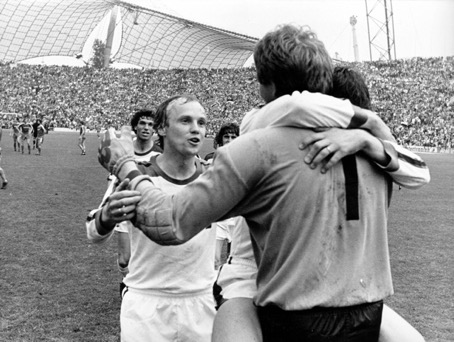
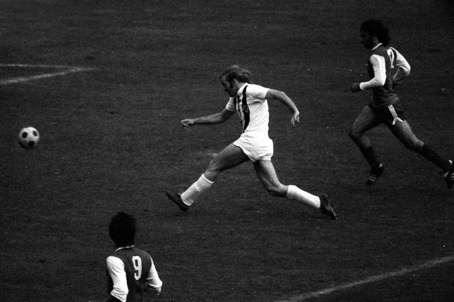
Special Moments
The Don and the Foals. How a man from Cologne became the chief of the farmers
1. FC Köln was my first home, my first posting as player-coach. Rheydter SV was a stopover, Viktoria Köln a step backwards. Borussia Mönchengladbach was my great fortune — the "Buuren" (farmers) from the Lower Rhine.
I started in Cologne with great ambitions. As player-coach and founding member, I was supposed to turn the newly established club into a German powerhouse. I believe I could have done it, had they let me. But "the boss" wouldn't let me work in peace — not the way I wanted. I wanted to build around young, local players and develop them into something special.
The new president, Helmut Beyer, his deputy Helmut Grashoff and Alfred Gerhards guaranteed me complete freedom and support for my "kindergarten concept" — the idea of betting on local and regional talent. They had no other choice, really. Money was tight, a star like Albert Brülls had been sold. But the club already had an excellent youth academy and a region full of raw talent.
Überhaupt: Franz Kremer baute mich auf, Franz Kremer ließ mich fallen. Wie Caesar und Pompeius. Wie Napoleon und Wellington. Wie Strauss und Wehner. Genau so sehe ich uns. Franz Kremer und mich. Wir übertrugen unseren privaten Konflikt auf unsere Vereine.
In the 1950s, the rivalry between us neighbours in North Rhine-Westphalia was still a peaceful coexistence. Limited interest in each other, but no trace of animosity. Borussia were even the first team to visit 1. FC Köln's new Geißbockheim. For the "Effzeh," the biggest Rhenish rival came from Dellbrück — they played Gladbach in the Oberliga West and in several league playoffs without any ill will.
I had served during the war and was taken prisoner near Danzig. I don't like talking about that time, even though it was probably the most formative period of my life. What kept me going was always my love of football. After returning home in 1945, a certain Franz Kremer persuaded me to play for my old club in Köln-Klettenberg. He was the new chairman — and would become both my greatest supporter and my greatest adversary.
In der Mannschaft spielten mindestens fünf Spieler besser als ich, aber ich besaß offenbar mehr Durchsetzungsvermögen. Ich machte mir mehr Gedanken um Fußball. Ich entwickelte eigene Ideen.
What I lacked in playing quality, I made up for with theoretical and technical knowledge. I lived and loved football, even though I visibly lacked talent. I recognised early on that my playing days were numbered, but a life without football was unimaginable. So in June 1947, I began training as a football coach at the Cologne Sports University — and graduated as the youngest coaching diploma holder in Germany.
As Köln's player-coach, I celebrated my first major success in 1949 with promotion to the Oberliga West. I still get goosebumps thinking about it. But sadly, my days on the Rhine were numbered. I could no longer meet the board's expectations, above all those of Franz Kremer. When we missed the German championship final in 1952, my time was up.
I found support from my former university lecturer and mentor, national team coach Sepp Herberger. I became his assistant, but I couldn't subordinate myself and ended the collaboration after just one year. What happened next was unexpected: Köln wanted me back. I remember how torn I was when I signed the contract — my lack of trust in Kremer hadn't changed, but the pull of the club was too strong.
Before long, we couldn't be in the same room without an argument escalating. Working together was impossible. I moved to the "schäl Sick" — the other side of the Rhine — to SC Viktoria 04. I enjoyed the trust and freedoms the Oberliga club afforded me, while my aversion to Kremer and his entourage grew daily. But the big breakthrough eluded me there too.
I found my new love on April 27, 1964, in Mönchengladbach, just 45 kilometres away. The club had just been left by coach Fritz Langner, who wanted to manage Schalke 04 in the Bundesliga. Sepp Herberger had put in another recommendation. And so I arrived at the Lower Rhine. In my luggage: many ideas and a large dose of resentment towards Cologne. Although — or perhaps because of it — the Foals became my life's work.
Wise Words
Quotes for eternity
"We're at the very top now and we're going to cling on. Let the others try to knock this world-class team off its perch."
Hans Meyer"Offside is when the tall arsehole plays the ball too late."
Hennes Weisweiler explains the offside rule. "The tall arsehole" is, of course… Günter Netzer„Ich habe es mir sehr genau überlegt und dann spontan zugesagt“
Toni Polster über seinen Wechsel zu Borussia Mönchengladbach"Thanks for the good wishes for Operation Promotion. You'll be kicking yourselves when we actually make it — because then nobody will be watching your show anymore."
Hans Meyer to a DSF reporter before Gladbach's 2001 Bundesliga return"Next time you need a coach for five matches, give me a call."
Hans Meyer to Bayern legend Franz Beckenbauer after the final matchday of 2008/09. Bayern had hired ex-Gladbach coach Jupp Heynckes as interim manager for five matches…„Bernhard Langer hat mal gesagt, Leistungssport spielt sich zwischen den Ohren ab“
Gladbach-Trainer Rainer Bonhof zur Nervenschwäche seines Teams"If you keep playing like this, you'll be champions by the end."
Schalke's Olaf Thon after a 0-3 defeat in Gladbach on matchday 1 of the 1998/99 season. They were not: Borussia were relegated from the Bundesliga for the first time…„Torwart Jörg Stiel hat gesagt, ich wäre sein bester Trainer gewesen. Später habe ich erfahren, dass er nur 2 hatte“
Hans Meyer